People often came to the house, but usually in the daytime. I was reading to my sister in the sitting room and heard my father answer the door.
From the shadows of the mudroom, a rough voice said “You owe a debt to Schipper van der Velde.”
“Yes. I will pay. After I sell The Young Soldier.”
“You will pay whether you sell or not.”
The visitor, a man with thudding footfalls followed him closely back to the studio.
I told my little sister to stay still, wrapped her in a blanket, then followed the men to the studio, dipping in and out of shadows.
Crouched outside the studio, I couldn’t see them but heard heavy hands landing flatly against clothing, an exclamation, feet shuffling and a body falling against furniture. Jars complained and books thunked to the floor. A canvas flapped flat, probably ruining the work in progress in the dust.
My father stepped into my sightline to open a cabinet inlaid with gold and jade, a gift from another sea captain, grateful for a grand portrait many years before my birth.
The man filled my foreground, the edges of his woolen cape fibers afire in reddish sienna in the window’s draining light. Father had more evening visitors like this lately. The man bumped shelves as he roughly flipped through canvases leaning against the wall. I held my breath and looked back toward the sitting room, hoping my sister had sense enough to stay put.
I was knocked sideways as the man burst through the door, his cape billowing. I heard the dull cha-lunk of gold in a leather purse slipping into his pocket. A small painting was tucked under his arm, likely worth vastly more to our family than the amount owed.
My father collapsed against the cabinet, curved like a prawn. He held his right wrist with his left hand, eyes closed, smaller than I had ever seen him. He was no great master tonight. Just a man in a dark, cluttered room.
“They are attacking from all sides, Titus. They will take and take until there is nothing left.” He turned and covered his eyes with both hands.
“How did you know I was here, Papa?”
“The shadows are always full of potential.”
I had heard this often. “Let me help you.”
He nodded. “Then help me with him,” and he gestured to the canvas on the easel, just an outline of a young man on a skinny horse. The face was defined. Father always started with the face. But the background was bare. “Alone, this boy will die.”
He reached for a brush and dropped it with a flinch.
I came to his side, touched his wrist, already hot and swollen. I drenched rags in cool water and bound his wrist, tight and stiff. He had me tie a palette knife to his palm, then used his whole arm, sweeping thick triangles of paint across the background. The knifed-on paint created ridges and points, an arduous terrain lay ahead for the soldier.
"How much was the painting he took worth?"
He grunted and waved the question away.
"Papa, you have to keep better records or they'll come back for more."
I would find other ways to help my father, but that night, I only knew how to take up the small brush to arm the boy with weapons. Arrows and a bow, a short sword and a knife, under my father’s direction, like a good apprentice. It was the least I could do for both of them.
Returning to the sitting room, I found my sister safely asleep in the sitting room and carried her to bed. The buyer I found for the young soldier soon after named our young soldier The Polish Rider.
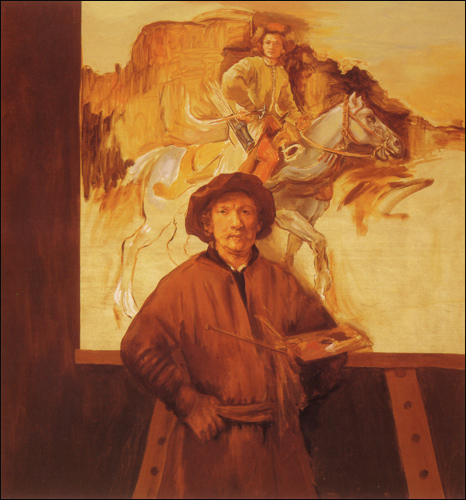
Exercise: Draw inspiration from a work of art. Based on Russell Connor's 1990-1993 ekphrasis work, itself based on Rembrandt's The Polish Rider, I imagined why that painting might have used both Rembrandt's early style and his later style. Read more about 'Hands Off the Polish Rider'
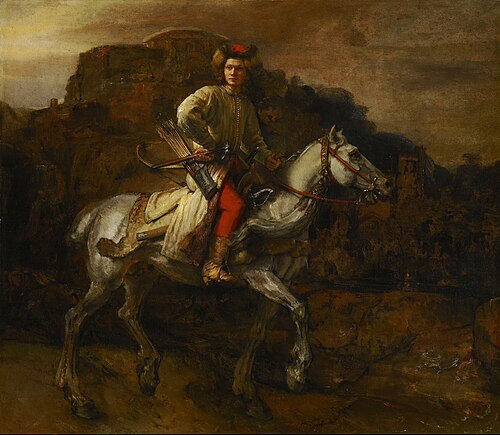
Rembrandt's The Polish Rider, 1865, The Frick Collection, New York. The heavy application of paint is called impasto. Rembrandt’s heavy use of the palette knife allowed him to step away from the smooth, polished surfaces preferred by many painters of the era. Instead, by building up layers of thick, opaque paint, he created physical textures that caught the light, adding incredible physical realism and dramatic depth to his subjects.